Data Cabling Installation Guide for LA Properties
[ez-toc]
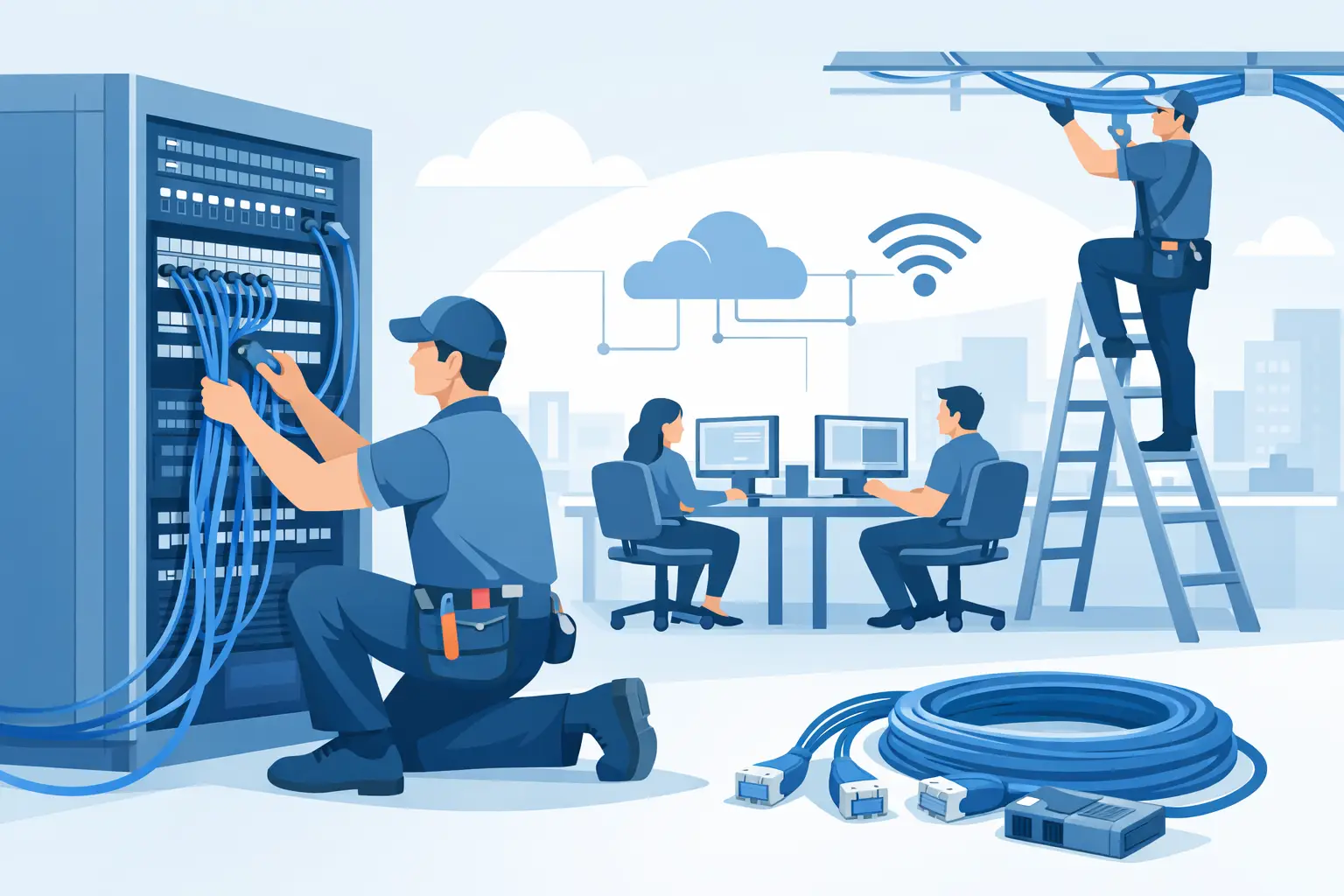
A slow point-of-sale terminal, dropped video call, or unreliable Wi-Fi access point often gets blamed on the internet provider. In many Los Angeles properties, the real problem is inside the walls: aging, poorly routed, or undocumented low-voltage wiring. This data cabling installation guide explains what property owners, managers, and business operators should expect from a properly planned installation.
Data cabling is the physical foundation behind computers, phones, cameras, wireless access points, access control systems, and many building-management devices. It is not a place to cut corners. A cable that works on installation day but cannot support future equipment, cannot be traced, or has not been tested can create recurring downtime and expensive rework.
Start With the System, Not the Cable
The first decision is not whether to use Cat6 or fiber. It is understanding what the cabling system must support now and over the next several years. A small office may need workstation drops, VoIP phones, printers, and wireless access points. A retail location may also need security cameras, registers, digital displays, and inventory devices. Industrial facilities may require connections for controls, monitoring equipment, and machinery in areas with electrical noise or difficult environmental conditions.
A site review should identify the main equipment location, such as a network closet or equipment room, along with every device location. It should also account for likely additions. Adding a few extra cable runs during construction or a tenant improvement is generally far less disruptive than opening finished walls later.
The equipment room deserves special attention. It needs sufficient wall or rack space, power, grounding where applicable, ventilation, and a clean path for incoming service and outgoing cabling. Leaving a switch, patch panel, and power equipment crowded in a cabinet with no room to service it is a common cause of future headaches.
Choosing the Right Cable Category
Copper Ethernet cabling remains the practical choice for many business and residential applications. Cat6 is widely used for current network needs and is a sound option for many offices, retail spaces, and homes. Cat6A may be appropriate when 10-gigabit performance, longer runs, or higher future capacity is a priority. It is thicker and less flexible than Cat6, however, so pathways and cable management must be planned accordingly.
Fiber optic cabling can be the better answer when connecting separate buildings, covering long distances, or supporting high-capacity backbone links. It is also not affected by the electromagnetic interference that can be present around certain industrial equipment. Fiber requires specialized termination, testing, and protection, so it should be designed as part of the full communications system rather than treated as an afterthought.
Cable selection depends on the application, distance, budget, pathway conditions, and equipment requirements. Installing the highest category cable everywhere is not automatically the best value. A qualified contractor can help separate genuine capacity needs from unnecessary expense.
Plan Routes That Protect Performance
Data cable is low-voltage wiring, but its installation still requires careful coordination with electrical systems, fire-rated assemblies, plumbing, HVAC, and structural conditions. Cable should follow accessible, supported pathways that allow future maintenance. Open, loosely draped cable above a ceiling may seem faster, but it is harder to troubleshoot, more likely to be damaged, and can create compliance concerns.
One critical consideration is separation from power wiring. Data cables can be affected by electromagnetic interference, particularly near high-voltage conductors, transformers, motors, fluorescent ballasts, and industrial machinery. The required separation depends on the installation conditions and applicable standards. Where crossings are necessary, the route and protection method should be selected carefully.
Penetrations through walls, floors, and fire-rated barriers must be properly sealed with approved firestop materials. This is not just a finish detail. An improperly sealed penetration can compromise a building’s fire-resistance rating and lead to problems during inspection. For occupied commercial spaces, clean routing and careful coordination also reduce disruption to tenants, employees, and customers.
Support, bend radius, and pulling tension matter
Network cable performance can be damaged without visible signs. Excessive pulling force, sharp bends, crushed cable, tight cable ties, and unsupported runs can alter the cable’s internal twists and reduce its ability to carry data at the intended speed. Professional installers use appropriate supports, maintain bend radius, and avoid overcrowding pathways.
This is especially relevant in older Los Angeles buildings, where available ceiling space and wall cavities may be limited. A careful installer evaluates the route before pulling cable rather than forcing material through an unsuitable path.
The Data Cabling Installation Guide to Termination and Labeling
A cable run is only as useful as its terminations and documentation. Each outlet should be terminated at a properly mounted jack, while the equipment-room end should land on a patch panel or other suitable connection point. Bare cables plugged directly into network equipment may save a small amount upfront, but they make maintenance, moves, and troubleshooting much harder.
Every cable should receive a clear, consistent label at both ends. Labels should correspond with a simple record showing the outlet location, patch-panel port, cable type, and test result. A property manager should be able to tell a service provider which outlet serves a camera, access point, office, or conference room without relying on guesswork.
Good labeling is particularly valuable after tenant turnover, remodeling, or an equipment upgrade. It turns a potential tracing project into a straightforward service task. For larger sites, cable schedules and as-built drawings provide an additional layer of clarity.
Testing Is the Proof of a Professional Installation
A cable that has continuity is not necessarily a certified data connection. Proper testing verifies performance across the installed channel, including factors such as wire map, length, resistance, signal loss, and interference. The appropriate test level depends on the cable category and project requirements.
Testing should occur after termination and before ceilings or walls are permanently closed whenever possible. If a problem is found at that stage, correcting it is simpler and less costly. The customer should receive test documentation for the completed runs, particularly for commercial projects, new construction, and larger tenant improvements.
Do not assume a successful internet connection proves every cable is correctly installed. A marginal connection may work for light use yet fail under higher speeds, Power over Ethernet loads, or future network upgrades. Documentation provides a baseline for troubleshooting later.
Consider Power Over Ethernet Early
Many modern devices receive both network connectivity and power through one Ethernet cable. This includes wireless access points, IP cameras, VoIP phones, door access equipment, and certain building controls. Power over Ethernet can simplify installation by reducing the need for a nearby receptacle, but it changes the planning requirements.
The network switch must provide adequate power capacity, and the selected cabling must be appropriate for the device load and pathway conditions. Bundled cables can retain heat, particularly when many are carrying power. This is another reason cable selection, bundle size, and installation practices should be handled by experienced professionals.
When to Bring in a Licensed Electrical Contractor
Low-voltage work may intersect with electrical service, equipment power, fire-rated construction, grounding, commercial occupancy requirements, or industrial environments. Those conditions call for a contractor who understands both communications infrastructure and the building systems around it.
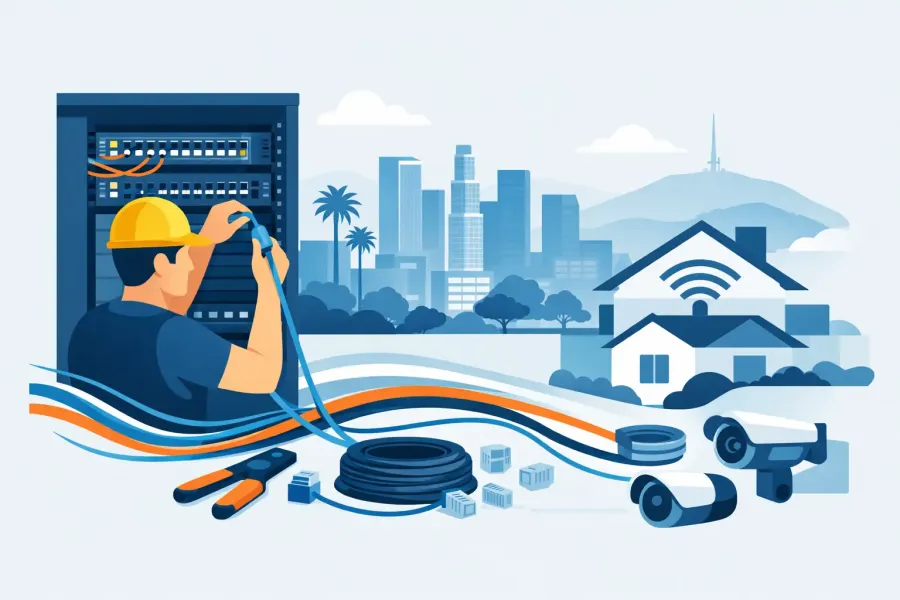
Prime Electric brings more than 40 years of electrical experience to data cabling work across Los Angeles-area homes, businesses, and facilities. Licensed and insured professionals can evaluate the route, coordinate with electrical requirements, complete clean installations, and help ensure the finished system is practical to maintain.
Before approving any installation, ask what cable category is proposed, where the equipment will be located, how the runs will be supported, whether each connection will be labeled and tested, and what documentation will be provided. You should also confirm who is responsible for patching, device connections, ceiling access, and any required repairs after the work is complete.
A well-planned cabling system is quiet when it is working properly. It gives your team reliable connections, gives future service technicians a clear starting point, and gives your property a better foundation for the equipment it will need next.