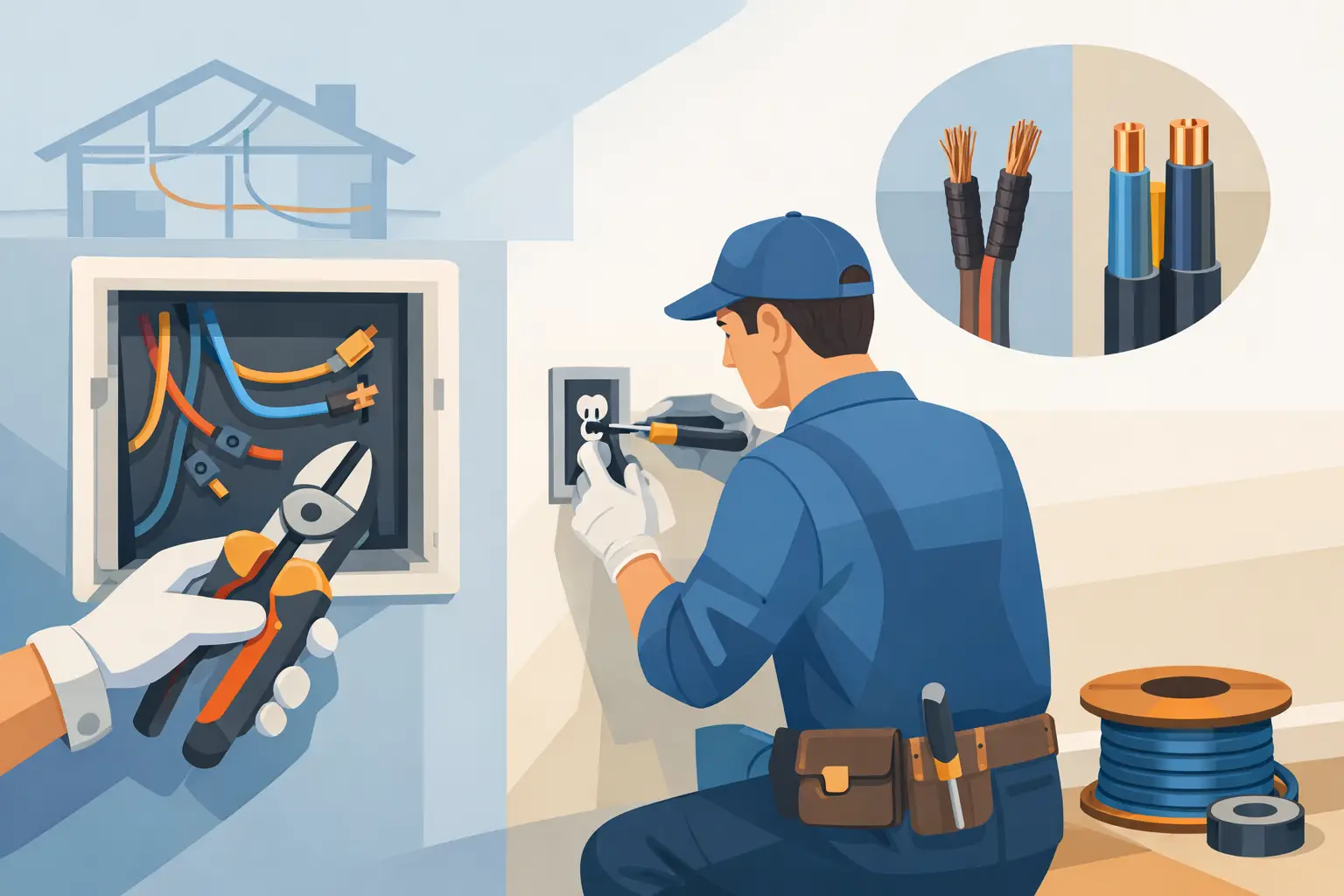
When Should House Wiring Be Replaced?

[ez-toc]
If your lights flicker when the AC kicks on, outlets feel warm, or breakers trip more often than they used to, the question is no longer theoretical. Homeowners usually start asking when should house wiring be replaced after they notice something feels off, and that instinct is often right.
Wiring does not come with a simple expiration date. Some systems last for decades, while others become unsafe much sooner because of poor installation, outdated materials, overloading, or damage hidden inside walls and attics. The right answer depends on the age of the home, the type of wiring, how much power the property uses today, and whether the electrical system has kept up with modern code and appliance demands.
When should house wiring be replaced in a Los Angeles home?
In many Los Angeles homes, wiring replacement becomes a serious consideration when the system is 40 to 50 years old, especially if it has never been upgraded. That does not mean every older house needs a full rewire immediately. It does mean the wiring should be professionally evaluated if the home still has original branch circuits, an outdated panel, ungrounded outlets, or visible signs of wear.
Older homes in neighborhoods across LA County often have electrical systems built for a very different lifestyle. Decades ago, a house might have powered a few lights, a refrigerator, and basic small appliances. Today, the same home may be running central air, multiple TVs, office equipment, kitchen upgrades, EV charging, pool equipment, and high-demand electronics all at once. Even wiring that was acceptable when installed can become undersized for how the property is actually used now.
The key point is this: replacement is not based on age alone. It is based on age plus condition, safety, capacity, and code compliance.
Clear signs your house wiring may need replacement
Some warnings point to inconvenience. Others point to real fire and shock risk. If you are seeing repeated electrical issues, it is worth treating them as a wiring problem until proven otherwise.
Frequent breaker trips are one of the most common signs. A breaker that trips once in a while may simply be doing its job. A breaker that trips repeatedly on normal household loads often means a circuit is overloaded, deteriorated, or improperly configured. If the same rooms have the same problem over and over, the wiring itself may be part of the issue.
Flickering or dimming lights can also be a warning. Sometimes the cause is minor, like a loose bulb or fixture issue. But if lights dim when large appliances start up, or multiple rooms flicker together, that can indicate voltage drop, loose connections, or aging conductors.
Warm outlets, warm switch plates, buzzing sounds, and burning odors should never be ignored. Those symptoms can signal loose terminations, arcing, or overheating inside the electrical system. In that situation, replacement may be necessary in the affected circuits, and sometimes much more.
You should also pay attention to outlets that do not have grounding, especially in older homes. Two-prong outlets, missing GFCI protection in kitchens and bathrooms, and patchwork modifications over the years can all point to a system that no longer meets modern safety expectations.
The age and type of wiring matter
Not all old wiring is equally risky. Some materials hold up better than others, and some have known safety issues.
Knob-and-tube wiring is a major example. If a home still has active knob-and-tube circuits, replacement is usually recommended. This wiring method was not designed for modern electrical loads, lacks grounding, and can become hazardous if it has been altered, buried under insulation, or spliced improperly over the years.
Aluminum branch wiring, commonly found in some homes built in the 1960s and 1970s, deserves close attention as well. Aluminum expands and contracts differently than copper, which can lead to loose connections and overheating if the system is not properly terminated and maintained. Not every aluminum-wired home requires a full rewire right away, but it does require evaluation by a licensed electrician with experience in corrective options.
Even older copper wiring can become a problem if insulation is brittle, conductors have been damaged, connections are loose, or decades of amateur additions have created unsafe conditions behind walls.
Replacement is often about capacity, not just damage
A house can have wiring that is technically still intact but practically no longer adequate. That is especially common during remodels, additions, or equipment upgrades.
If you are adding an EV charger, upgrading HVAC equipment, renovating a kitchen, installing new lighting, or converting a garage or ADU, your existing wiring may not support the new load safely. The same goes for older rental properties and commercial spaces that have been adapted over time without a coordinated electrical plan.
In those cases, replacement may be partial rather than total. A whole-house rewire is sometimes the right move, but many properties only need certain circuits replaced, new dedicated circuits added, the panel upgraded, or grounding and protection brought up to standard. That is why a proper inspection matters. You want to solve the actual problem, not guess at it.
When partial rewiring makes sense
Homeowners often assume the only two choices are do nothing or rewire the entire home. In practice, there is a middle ground.
If the problem is isolated to a damaged section, a remodeled area, an overloaded kitchen, or outdated wiring in one part of the property, partial rewiring can be a smart and cost-effective option. This approach is common when the main service is in decent condition and only certain branch circuits are failing or obsolete.
That said, partial repairs can become inefficient if the house has widespread issues. If multiple circuits are ungrounded, the panel is outdated, and electrical problems are showing up in different rooms, piecemeal work can end up costing more over time. In that situation, a more comprehensive upgrade usually makes better financial and safety sense.
What a professional evaluation should look for
A licensed electrician should do more than glance at the panel and make a quick guess. A real assessment looks at the age of the system, the type of wiring materials, grounding, breaker performance, visible terminations, load demands, and signs of previous unpermitted or makeshift work.
The inspection should also account for how the building is used. A single-family home, a duplex, a retail space, and an industrial workspace all place different demands on wiring. The goal is not just to determine whether the system still turns on. The goal is to determine whether it is safe, code-conscious, and dependable for current and future use.
This is where experience matters. An established contractor can usually tell the difference between a house that needs a few targeted corrections and one that is overdue for a broader wiring replacement.
Why waiting too long can cost more
Electrical wiring problems rarely improve on their own. Small issues tend to compound. A loose connection creates heat. Heat damages insulation. Damaged insulation increases the risk of arcing and failure. What starts as an occasional nuisance can turn into wall damage, appliance damage, failed inspections, or a serious safety event.
For property owners and managers, there is also the issue of reliability. Tenants, buyers, and business occupants expect safe and functional power. If the wiring cannot support normal use without tripping, dimming, or overheating, the property becomes harder to maintain and more expensive to keep patching.
For that reason, the best time to address wiring concerns is usually before a major failure, not after one.
So, when should house wiring be replaced?
House wiring should be replaced when it shows signs of deterioration, uses outdated or unsafe materials, lacks grounding or modern protection, or cannot handle the electrical demands of the property. In many cases, that conversation starts when a home reaches 40-plus years old, but the real decision comes down to condition and performance.
If your property has recurring electrical issues, original wiring from decades past, or planned upgrades that increase demand, it is worth getting a professional inspection. Prime Electric has served Los Angeles-area homes and properties for more than 40 years, and this is exactly the kind of issue where licensed, experienced guidance makes the difference.
Good wiring stays out of your way. It should be safe, stable, and ready for how you actually live or operate your property now – not how someone used it half a century ago.