EV Charger Installation at Home Made Simple
[ez-toc]
Pulling into your garage and plugging in overnight is convenient – but ev charger installation at home is not just about mounting a box on the wall. The real work is making sure your electrical system can handle the added demand safely, consistently, and up to code. For Los Angeles homeowners, that often means looking at panel capacity, breaker space, wiring distance, permit requirements, and where the charger will actually be used day to day.
A lot of people start by asking whether they really need a Level 2 charger. The answer depends on how you drive. If you commute daily, have more than one EV, or want faster charging than a standard wall outlet can provide, a dedicated home charger usually makes sense. Level 1 charging from a regular 120-volt outlet can work for some drivers, but it is slow. For many households, it quickly becomes inconvenient, especially when driving habits change or a second electric vehicle enters the picture.
What ev charger installation at home usually involves
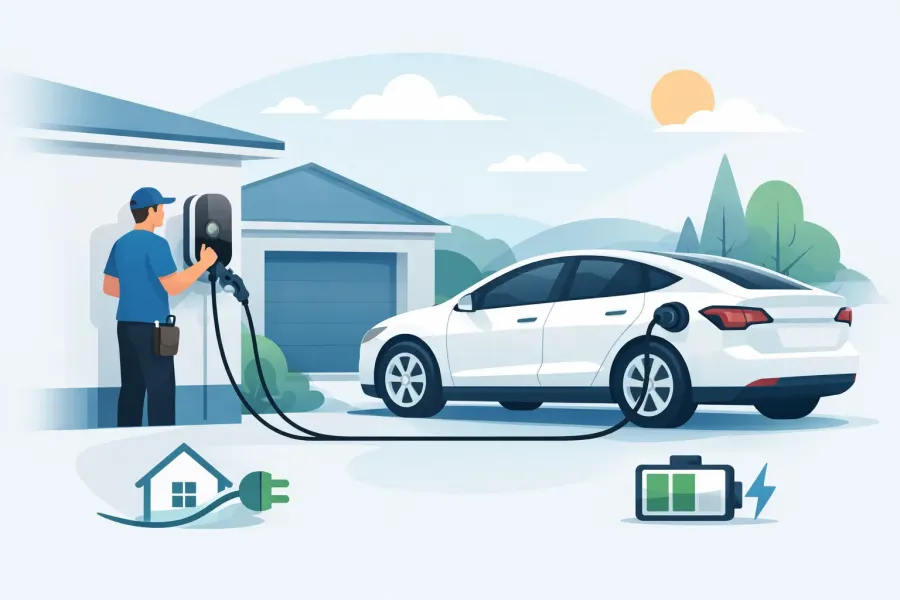
Most homeowners picture a charger mounted near the parking space, connected to a new dedicated circuit. That is often true, but every home has its own electrical conditions. An electrician will usually start by checking your main service panel, available amperage, current electrical load, and the distance between the panel and the charger location.
If the panel has enough capacity and open space, the installation can be fairly straightforward. If it does not, the project may require a subpanel, load management equipment, or a full panel upgrade. That is where experience matters. A charger that works well on paper can still create problems if the home’s electrical system is already near its limit.
Placement also affects the scope of work. A charger installed on the garage wall next to the electrical panel is usually simpler than one mounted on an exterior wall or at the far end of a driveway. Longer wire runs, trenching, conduit routing, and weather protection can all change the price and timeline.
Level 1 vs. Level 2 charging
For most homeowners, the conversation comes down to speed and practicality. Level 1 uses a standard household outlet and adds range slowly. It may be enough for a low-mileage driver who has plenty of time between trips. The trade-off is that charging can take a very long time, and the outlet itself may not be ideal if the wiring is older or shared with other loads.
Level 2 charging uses 240 volts and delivers much faster results. This is usually the preferred option for home charging because it is more practical for daily use. You get shorter charging times, better convenience, and a setup designed specifically for the vehicle instead of relying on a general-purpose outlet.
There is also a difference between plugging into a 240-volt receptacle and installing a hardwired charger. In some cases, a plug-in setup makes sense. In others, hardwiring is the better choice for durability, code compliance, or manufacturer requirements. The right answer depends on the charger model, local code, and the conditions at your property.
Your electrical panel matters more than the charger
One of the biggest variables in ev charger installation at home is the panel. A charger may need a 40-amp, 50-amp, or higher dedicated circuit depending on the equipment and desired charging speed. If your panel is older, already full, or undersized for your home’s current needs, adding an EV charger may expose issues that have been there for years.
This is common in older Los Angeles homes. Between HVAC systems, kitchen upgrades, spa equipment, and added appliances, many panels are carrying more than they were originally designed to support. Installing a charger without checking load calculations and code requirements is not a shortcut worth taking.
A qualified electrician should evaluate whether your existing service can support the charger safely. Sometimes the solution is simple. Sometimes the smarter long-term move is a panel upgrade that prepares the home for future electrical demand as well.
Signs your home may need upgrades first
If breakers trip regularly, lights dim when large appliances turn on, or your panel uses outdated equipment, those are warning signs. A panel with no available breaker space is another obvious issue. Even if everything appears to be working, that does not automatically mean the system has enough capacity for a dedicated EV circuit.
This is why a site assessment matters. It protects the charger, the vehicle, and the rest of the electrical system.
Permits, code compliance, and why they are worth it
Homeowners sometimes ask if permits are really necessary for a charger install. In a properly handled job, yes. EV charging equipment is a substantial electrical addition, and permit requirements are there for a reason. They help verify that the work is being done safely, with correct wiring methods, proper overcurrent protection, and compliant installation practices.
Skipping permits can create problems later, especially if you sell the property, file an insurance claim, or run into an issue with the charger. Code-compliant work is not just about passing inspection. It is about protecting your home and avoiding expensive corrections.
A licensed and insured electrician should understand local requirements, secure the right permits when needed, and complete the installation in a way that stands up to inspection.
What affects the cost of ev charger installation at home
There is no one-price-fits-all answer because the electrical conditions vary so much from one property to the next. A simple installation near the main panel will usually cost less than a charger placed far from the panel with extensive conduit runs or trenching. If the panel needs to be upgraded, that will increase the project cost significantly.
The charger itself also matters. Some homeowners already have equipment and only need installation. Others want help selecting a charger that fits their vehicle, charging habits, and budget. Hardwired units, smart chargers, weather-rated equipment, and higher-amperage setups all affect final pricing.
In practical terms, the main cost factors are panel capacity, wiring distance, charger type, permit requirements, and whether any service upgrades are needed. That is why accurate estimates usually require an on-site evaluation rather than a quick guess over the phone.
Choosing the right charger for your home
The best charger is not always the fastest one available. It should match your vehicle, your electrical service, and how you actually use the car. Some homeowners want app-based controls, charging schedules, and energy tracking. Others just want dependable overnight charging without extra features.
If the home has limited electrical capacity, it may be better to install a charger with adjustable amperage or load management capability instead of forcing a larger setup. If the charger will be outdoors, the unit and installation method need to be rated for that environment. If multiple EVs are likely in the future, that should be part of the planning now rather than after the first installation is complete.
An experienced electrician can help you avoid buying equipment that does not fit the property or creates unnecessary installation costs.
Why professional installation matters
An EV charger is a high-demand electrical load that is used for long periods at a time. That is not the place for guesswork, reused breakers, undersized wire, or improvised outlet installations. Safe charging depends on correct load calculations, proper breaker sizing, approved materials, and workmanship that meets code.
It also depends on clean execution. A professional installation should look organized, operate reliably, and make sense for the way you park and charge every day. The goal is not just to get power to the charger. It is to create a setup that is safe, durable, and convenient for years.
For homeowners who want that work done without uncertainty, Prime Electric brings the kind of licensed, insured, reputation-backed service that matters on projects tied directly to safety and long-term reliability.
How to prepare for your estimate
Before scheduling service, it helps to know where you want the charger, what vehicle you drive, and whether you already have a charger selected. If possible, note the age of your panel, whether there is garage access, and if the charger location is indoors or outdoors. Those details can help move the estimate process faster.
Still, the final recommendation should come from a real evaluation of the home. Good electricians do not promise a perfect answer before seeing the panel, the parking setup, and the path the wiring needs to take.
The best home charging setup is the one that fits your house as well as your vehicle. When the electrical side is planned correctly from the start, charging becomes the easy part.